
 Politicians seem to have shrunk. My brother and I were chuntering about it recently: how the figures we grew up with appeared more substantial, some even approaching the once-serious idea of statesmanship – a word that now feels faintly antique.
Of course, the world was different. Times change, and so do our perceptions. Still, one tangible difference was that many of those politicians – mostly men – had lived their adult lives through at least one war, and that experience seemed to lend them an anchoring gravitas. Harold Macmillan, who became prime minister in 1957, for example, was much derided in my Labour-voting household, but at least he seemed to be a grown-up.
It wasn’t only the Conservatives. On the Labour side too, figures of that generation appeared – at least – to possess greater weight and seriousness. Britain’s changing role in the world, along with the relentless glare of modern media, may also shape how we now perceive political authority.
Whether they really were more substantial, or whether this is simply the distorting effect of distance, is harder to say. When you actually read history, it turns out they were muddling through too. They just did it in frock coats or moustaches, without a camera or microphone in their faces, and sometimes with the clarifying pressure of revolution, invasion, or aerial bombardment bearing down.

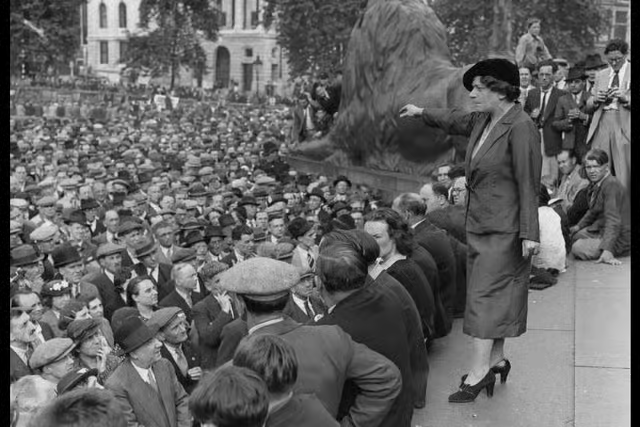
That quality – whatever we choose to call it – would certainly apply to Macmillan’s contemporary Ellen Wilkinson, “Red Ellen”, a member of Attlee’s post-war cabinet who died before I was born.
The featured image shows her addressing a huge crowd in Trafalgar Square on 11 July 1937, speaking in support of Spain. Dubbed the “mighty atom” and the “fiery particle” – she stood just four foot ten – Wilkinson was a formidable force to be reckoned with.
Red Ellen
Ellen Cicely Wilkinson (1891–1947), known as “Red Ellen” for her flaming hair and uncompromising politics, lived a life so crowded with upheaval, travel, argument, and reform that it reads like a compressed history of the British left in the first half of the twentieth century.
 I’ve just read Laura Beers’s wonderfully detailed biography – Red Ellen, The Life of Ellen Wilkinson, Socialist, Feminist, Internationalist – and what a treat it was.
Wilkinson’s life was short – she died at fifty-five – but there was scarcely a movement, cause, or major political figure of her time with which she was not connected. Born in Manchester to a striving working-class family, she was shaped by two strong influences: a self-educated Conservative lay-preaching Methodist father who believed in moral seriousness and social justice, and a devout Liberal-leaning mother whose faith grounded her early life.
“By the time I was fourteen,” Wilkinson later wrote, “I was reading Haeckel and Huxley and Darwin with my father… I didn’t get this fuzzy mess sorted out until I discovered Karl Marx in my early twenties.”
Socialist Convert
Beers has a wonderful account of how Wilkinson came to embrace socialism. At sixteen she became a pupil teacher at Manchester Day Training College and agreed to stand as the school’s Socialist candidate in a mock election. Preparing for the debate converted her. She later recalled:
“Here was the stuff I was looking for… Blatchford made socialists in those days by the sheer simplicity of his argument. I went into that election a flaming socialist.”
“I learned all too early that a clear decisive voice and a confident manner could get one through 90 per cent of the difficulties of life.”
She joined the Independent Labour Party at sixteen, embraced women’s suffrage, and won a scholarship to the University of Manchester. There she combined academic brilliance with political immersion – Fabian meetings, suffrage organising, and encounters with radical thinkers honing the skills that would later make her such a formidable speaker.

The Russian Revolution thrilled and galvanised her. She helped found the Communist Party of Great Britain and travelled to Moscow, meeting Trotsky and Lenin’s widow, Krupskaya. But she believed power in Britain ran through Labour. When dual membership was banned, she chose Labour, and in 1924 was elected MP for Middlesbrough East – the only new Labour woman that year – instantly recognisable for her red hair, bold clothes, and fierce opinions.
Elfin Fury, Fiery Particle, and Mighty Atom
Once in Parliament, the press dubbed her the “elfin fury”, the “fiery particle”, and the “mighty atom”. Her height was variously recorded between 4′9″ and five feet; she claimed 4′10″. On the Commons benches she propped her feet on a large attaché case.
 She backed the 1926 General Strike, raised funds in the United States for locked-out miners, wrote journalism, political theory, and a novel about the strike (Clash,1929), and campaigned relentlessly for women’s rights, pensions reform, and birth control. In 1930 she published Peeps at Politicians, a witty set of parliamentary pen-portraits that deserves a post of its own.
Defeated in Labour’s 1931 rout, she remained politically active. She travelled to India, meeting the imprisoned Gandhi and later visiting him at his ashram; befriended Nehru; exposed early Nazi brutality in Germany; reported on Spanish miners and the Spanish Civil War; and warned against fascism and appeasement long before Munich.

Her name is inseparable from Jarrow, a town devastated by the collapse of its shipbuilding industry. Elected as its MP in 1935, she led the 1936 Jarrow March – two hundred unemployed men walking to London to demand work. The march failed in immediate terms but succeeded symbolically, searing mass unemployment into the national conscience. Her account, The Town That Was Murdered (1939), fixed Jarrow in public memory.
On her fourth trip to the United States, in February 1937, Wilkinson climbed through the window of a Ford Motor plant in Flint, Michigan to express her solidarity with the strikers who had occupied the plant. Her presence in Flint highlighted the international support for the American labor movement in this pivotal struggle for union recognition.
During the Second World War Wilkinson entered Churchill’s coalition, earning the nickname “the shelter queen” for driving the rollout of Morrison shelters during the Blitz.
In 1945 Attlee appointed her Minister of Education – only the second woman ever to sit in Cabinet. She implemented the 1944 Education Act, raised the school-leaving age, expanded school meals and milk, recruited emergency teachers, and chaired the conference that founded UNESCO.
Ill, and exhausted by years of overwork and strain, she died in 1947 at just fifty-five. Red Ellen began as a revolutionary firebrand and ended as a pragmatic reformer, but the through-line never wavered: an unyielding belief that politics should improve the lives of ordinary people.
And she also wrote a crime story.


Extraordinary woman. It is not surprising, though a shame she burned out so soon. I agree that the politicians of my childhood and youth seemed far greater, likely for the reasons you give. And maybe they all look better in black and white. I didn’t know the story of Macmillan in the shell hole.