In 1903, when Josephine Herbst was six years old, her mother took her four daughters on a reduced-fare train ride to Portland, Oregon.
We lived in Sioux City, Iowa, and we might have been dropped accidentally by some great auk on a transcontinental flight, so unreasonable it seemed that we were stranded in the middle of a country that offered its most tempting gifts to the people who lived on the eastern seaboard, “back East,” where my parents had been born and raised, or “out West” on the Pacific, where more fortunate relatives had been safely transported beyond our own barren middle ground. In Iowa you didn’t have a chance to see a mountain or to hear the ocean roar. And before that enchanted summer, I had never seen white ocean sand or known what it was to sit on it when scorching hot from a strong sun or that you could fill an empty bottle with hot sand and pour it down the open front of your blouse to flow in a tickling trickle over the hourglass of your ribs and thighs until it filled your bloomers to bursting and then slowly leaked away past the rubber band above the knees to seep like water into sand.
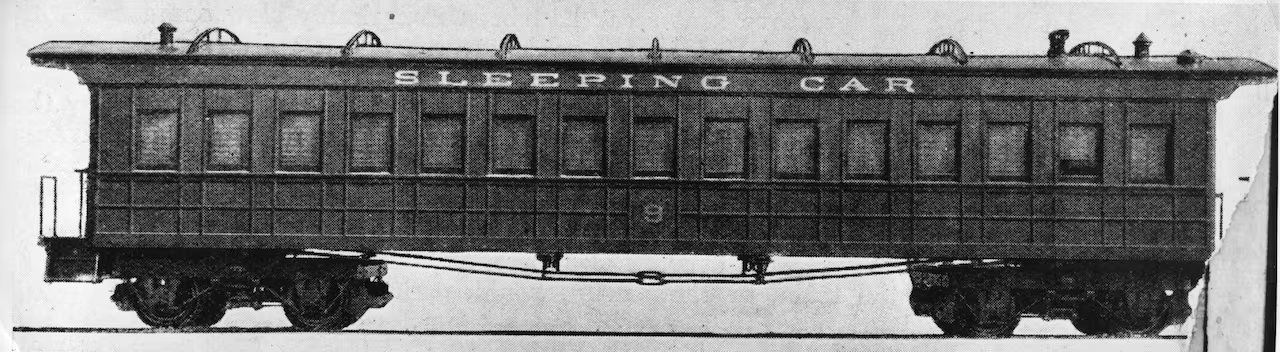
Circa 1875: A Pullman Pioneer sleeping car, the first sleeper it made.
We rode for three days and nights in a wonderful train called a tourist Pullman, where the seats were upholstered in a straw-colored matting and smelled of hay, like the matting on the floors of our bedrooms at home when the sun burned. Every one of the passengers in our coach had a big basket of food, for there was no diner. At the back of the car was an upright stove with two burners, where my mother made hot cocoa for her brood and a stout woman wearing a stylish shirtwaist of pink-striped cotton fried eggs. The porter was our friend, setting up a little table for us to eat on and to play dominoes on when it got too dark to look out the window. Everyone on the train was a fascinating stranger. A young man with a violin serenaded us after we had crawled into our bunks; the two older girls, who were fourteen and twelve, slept upstairs, while my mother and her two youngest slept in a chummy heap below; the youngest was three. There was a gents’ room and a ladies’ room, with an aisle between, but at the other end of the car, near the stove, there was a tap for drinking water and a towel to wipe the hands. An old man introduced me to the amenities of life by delicately wetting the tips of his fingers as I wiped my own hands and informing me, in what I took to be gospel truth, that two who wiped their hands on the same towel simultaneously would be friends forever. But everyone seemed to want to be friends forever. An old German couple from Milwaukee had brought a big hamper crammed with crocks of fresh apple butter, long sausages, great round loaves of bread, whole chickens, a ham. Because my mother acted as their translator when the conductor came through, we got big wedges of cheese, the legs and wings of a fat hen.
The interior of a Chicago and Alton Railroad Pullman car circa 1900.
All day we sat with our noses glued to the windows as the incredible panorama unwound itself: plains sprouting wheat; plains sprouting stones; mountains rough and wild. Once my mother roused her two youngest at dawn: “Look, sheep!” As we looked out on a bleak Montana plain inhabited bv a flock of stones, one stone moved, then another. A black shape reared, and we saw a dog’s frenzy; the heap of stones got up and walked. Once we saw a bison with head down, lonely and frantic, stirring up spurts of dust as it raced toward the distant mountains. Long, stringy waterfalls slid like crystal glass down the sides of giant cliffs; rivers ran snakv green far below our valiant locomotive, which, humanly energetic, panted and puffed, scattered red sparks, and, in stations, stood docile, sweating steam and heaving passionately for breath. In Portland, we left our sleeper, bought a box of fat juicy strawberries, and ate them on the train to Salem. – “The Magicians and Their Apprentices,”
That’s how the first of the four essays Herbst’s essay collection The Starched Blue Sky of Spain (1991) begins.
I just love that image of the child in bloomers to her knees joyfully filling herself with the sand on the first beach she has known and the magic of the long journey west.
Complicated, Conflicted, and Compromised
The Starched Blue Sky of Spain features four pieces: “The Magicians and Their Apprentices,” opens the book and recounts her early life in Sioux City in the first years of the twentieth century; “A Year of Disgrace,” originally published in The Noble Savage in 1961, details her romance and marriage to John Herrmann; the title essay describes her experiences in the Hotel Florida during the Spanish Civil War; and the closing “Yesterday’s Road,” written in 1968 shortly before her death reflects on her attendance at the 1930 Soviet Union International Conference of Revolutionary Writers in Kharkov.
The more Herbst I read – and the more about Herbst I read – the more complicated, conflicted, and contradictory she becomes.
Herbst had that lucky journalistic knack for finding herself at the heart of significant historical and literary moments. In the early 1920s, she immersed herself in New York’s literary intellectual scene and worked for H. L. Mencken’s magazines. She had an affair with the playwright Maxwell Anderson who, however, had no intention of leaving his marriage. When Herbst became pregant he pursuaded her to have an abortion.
She went to Germany and lived in Weimar-era Berlin In Paris, she mingled with the ex- pat literary circle, where she met figures like Ernest Hemingway and became his friend. In 1930, she attended the International Union of Revolutionary Writers’ congress in Kharkov, Soviet Union with her then husband John Hermann who became a committed Communist. She reported on the Scottsboro Boys trial for The New Masses, covered farmers’ strikes in Iowa and Nebraska for Scribner’s, and served on a writers’ committee – with Theodore Dreiser and John Dos Passos – investigating violence against miners in the Kentucky coal fields.
Her journalism reached wide audiences and earned admiration for its sharp coverage of the era’s political upheavals.
In the 1930s, Herbst balanced intensive fiction writing with activist reporting, often retreating to a rustic farmhouse in Erwinna, Pennsylvania, originally purchased by John Herrmann’s family. Her close friends included leading writers of the day, such as Dos Passos, Katherine Anne Porter, Nathanael West, and Hemingway; she occasionally joined the latter’s group in Key West for winters and went fishing with him.
Her most memorable reporting from the 1930s took her abroad. In 1935, she went to Cuba to document the resistance against land seizures. She returned to Germany, and wrote in-depth articles on the Nazi regime for the New York Post and The Nation. In 1937, she traveled to Spain as one of the few women journalists given access to frontline areas during the Civil War.
Through all this, she continued publishing novels and her enduring – although often rocky – friendships with major American authors generated a vast body of correspondence.
In spite of all these wide-ranging achievements and acclaim, Herbst spent her final years in poverty and relative isolation at the Erwinna farmhouse, which she never owned and which lacked central heating or indoor plumbing. She relied on support from friends, and her legacy was overshadowed by political controversies, accusations, and betrayals, by the chilling shadows of the McCarthy era, by her ex-husband John Herrmann’s alleged role in Communist espionage networks (including introducing Whittaker Chambers to Alger Hiss), and by the painful personal fallout from those revelations and personal betrayals – complexities I am only now beginning to understand.
It was all a long way from turn of the century Sioux City, Iowa.
Some of that contradictory nature was captured by her lover Jean Garrigue who wrote two poems in her memory and dedicated her fable The Animal Hotel (1966) to Herbst.
For J.
I think of that grave woman in the dark
There by the delicate stream at the pitch of moon,
Valor encompassed by the rare serene.
Difficult life has battered her and yet
With what magnificent strength she outstands that
No matter that the earth be dark and worn.
Might I learn, wasted and much torn From whence she gets the laughter of her kind. Giving and blessing, it enkindles mind And on the heart its wisdom without rancor fiery-earned Bestows such light that all seems round And brought to full, like our redemptive moon.
– Jean Garrigue
Garrigue also wrote :
In Memory Josephine Herbst (1897-1969) You believed in a world that has never come With or without hope of this one And therefore you would say “I believe in what I do not see” Insurgently or laughingly And walked through parts of your storm With angels of the enfranchised one That had been truly born, Turning the mocking cheek also: “Who’s interested now in / ‘Ah, wretched soul!'” Who, indeed, in a new world Where the heart might pulse Fresh, disinterested at last For everything outside itself But where, indeed, was that, Contradictory dissenter? And who more full of nature, Broad, human nature, Who more indwelling Than you or that loud poet Out in the fields of feeling? Nothing was trivial for you Nor the angular barn in the meadow At the foot of the broken stones.
I am still working out what to do with Josephine Herbst. There is far more to learn, to reckon with, and to think through.
References: Diane Johnson’s introduction to and NYTimes Alfred Kazin Review of THE STARCHED BLUE SKY OF SPAIN And Other Memoirs.By Josephine Herbst.Introduction by Diane Johnson New York:HarperCollins Publishers. Hilton Kramer’s essay Who was Josephine Herbst NYTimes Obituary: Shea, Mary Anne, Marjorie Garrigue Smith, Jane Mayhall, Stanley Kunitz, Arthur Gregor, Robert A. Wilson, Nancy Sullivan, May Swenson, Richard Eberhart, and Aileen Ward. “Jean Garrigue (1913-1972): A Symposium.” Twentieth Century Literature 29, no. 1 (1983): 1–44. https://doi.org/10.2307/441141.
Sounds like a very good bio subject! Incidentally, I’ve taken that train trip from Iowa to CA and from Iowa to NYC and you get a real sense of how much country there is between the two cosmopolitan coasts.,
I agree. A fascinating life right there in the middle of all the international political turmoil of the C20th. With passionate love affairs with both sexes.
But now I’m more interested in hearing about those two train journeys.
I love her recounting of the train journey from Sioux City. Train journeys are always interesting and back then would have been wondrous. Clearly, she was a busy and complex woman. I wonder what she would make of modern politics. Basically, has anything changed?
I’ve sometimes come across her name but had not read anything by her before this. She’s one of those writers whose star shone brightly and whose lives were tangled up in the politics of the C20th and then forgotten and neglected.



 Her journalism reached wide audiences and earned admiration for its sharp coverage of the era’s political upheavals.
Thank you, Josie, for another fascinating post – I have learned so much from you!
Sounds like a very good bio subject! Incidentally, I’ve taken that train trip from Iowa to CA and from Iowa to NYC and you get a real sense of how much country there is between the two cosmopolitan coasts.,
I agree. A fascinating life right there in the middle of all the international political turmoil of the C20th. With passionate love affairs with both sexes.
But now I’m more interested in hearing about those two train journeys.
I love her recounting of the train journey from Sioux City. Train journeys are always interesting and back then would have been wondrous. Clearly, she was a busy and complex woman. I wonder what she would make of modern politics. Basically, has anything changed?
So interesting! I knew nothing about this author before…
I’ve sometimes come across her name but had not read anything by her before this. She’s one of those writers whose star shone brightly and whose lives were tangled up in the politics of the C20th and then forgotten and neglected.