Auden and Isherwood had already sped west to the US
Poetry and the landscape are changing – and the poets are on the move. On a train leaving Paddington, to be precise, on a Sunday in April c.1943, in a special carriage stuffed with them.
Joseph Gurnard’s Poets’ Excursion is an extended metaphor of the shifting tide of British poetry and of the changing face of the landscape poets wrote about.
All Aboard
Much merriment ensues as poets and poems jostle for attention, are referenced, skewered, and lampooned with a light, good-natured hand. As they set off, there are a few awkward moments. One grandiose poet begins proclaiming his greatness and is roundly condemned as an earwig. Stephen Spendlove breaks the tension by launching into his own poem about a steam train, The Express:
After the first powerful, plain manifesto The black statement of pistons, without more fuss But gliding like a queen, she leaves the station. Without bowing and with restrained unconcern She passes the houses which humbly crowd outside, The gasworks, and at last the heavy page Of death, printed by gravestones in the cemetery. Beyond the town, there lies the open country Where, gathering speed, she acquires mystery, The luminous self-possession of ships on ocean. etc. etc.
Fortunately, Spendlove is interrupted by a screech of the brakes and a lurch that tosses them all out of their seats.
Order is restored and the poets – now with Edward Thomas back among them – steam through the English countryside. It is, of course, full of the storied, settled, pastoral, poetic past. Recognize any references?
Some on the train would like to get off right there and retire in peace
But progress is relentless and change happens.
East Coker: All change here!
“East Coker! East Coker for West Coker, Chard Mundam, Lancelot St. Andrew’s, Milton Undersod, Wastelands, Croup, and Clinkers-in-the-Vestry! All change here!”
Protesting they changed. And while they wait for the next train they are greeted by the Rev. J. Alfred Prufrock in his plimsolls, who offers to show them around.
“A cruel April,” he begins pleasantly, before recommending, recommending a bottle of stout to go with their sandwiches.
From Eliot the poets of the late twenties and thirties learned that the industrial landscape of gasworks, canal banks and grubby passageways and pub talk could be the subject of poetry. And many of them ran with it. Some of the merry band of brothers stay behind, still attracted by Rats’ Alley and the canal backs. The rest steam away from the brown and violet half-light enveloping East Coker toward a future landscape under bluff skies. This is the new countryside! This is the new poetry!
“Everywhere trippers in shorts and on bicycles poured along the roads, swarmed up lamp-posts, threw caps in the air. Pylons! Arterial roads, semi-detached villas, Butlin’s camps, ping-pong, scooters! Hurrah! But chiefly the pylons. We craned our necks to get a closer view of these Martians, representative of a new leisure and mastery, striding the hills. ‘Like nude giant girls,’ said Stephen Spendlove with that wonderful felicity of his for daydreaming.” – Poets’ Excursion, Joseph Gurnard in Penguin New Writing (1943).
Spender – and his “pylon poem” – get the brunt of the ridicule.
The Unquiet Landscape
And yet, ridiculed or not, the poets were sensing something real: the physical landscape of England was changing and there was also a shift in how it was imagined and represented. The traditional England – already mourned a century before by John Clare – was slipping away. The artist F.L. Griggs felt this keenly.
I was introduced to Griggs’ work via this review of Christopher Neve’s magnificent book Unquiet Landscape: Places and Ideas in 20th-Century British Painting
Early in the book Neves highlights F.L.Griggs (1876 – 1938), an illustrator, and draughtsman who became known for his highly detailed etchings of idealized medieval towns, cathedrals, and pastoral scenes. Here’s how Neve introduces him. The chapter is titled Black and the first of two sections is F.L Griggs: Lost England
I would like to write about black. The black of etchings is blacker than ink. A very diminutive etching can contain, within a few centimetres, more darkness than is enclosed at night by a Gothic cathedral.
At first, when F. L. Griggs went down English lanes in the first summers of the century, the darkness was hidden, just as darkness does hide in daytime. Griggs was in his mid-twenties and his brief was to draw black and white illustrations for the new Macmillan series of unhurried country guides called Highways and Byways. The task must have seemed a godsend. He had studied architecture and worked as an architectural draughtsman, but he was by nature a passionate lover of the English countryside and the way in which it gently contained its old buildings. He was not a builder but a recorder. .
Frederick Landseer Griggs (1876–1938)
The counties of England lay spread out in the sun. No traffic to speak of, no arterial roads, no pylons. To us it would have seemed almost imperceptibly quiet. At first on a bicycle and then by Rex motor-tricycle, he made his way slowly about, observing and drawing, county by county, starting with Hertfordshire in 1902 and concentrating all summer on Sussex in 1903. He had a fastidious nature and believed in topographical accuracy. He admired architectural complexity but he was eager to show buildings clearly and as simply as possible, revealing their logic. It was the last chance to show England as it was, and in him the moment had its ideal illustrator.
Anglia Perdita – Lost England (1915)
Anglia Perdita – Lost England (1915) is an imagined medieval townscape, complete with churches, towers, and walls. It evokes an England that never wholly existed, yet embodies what Griggs longed for: permanence, order, and spiritual unity.
Here’s another example – Owlpen Manor (1930s etching). This is based on a real Gloucestershire manor house, but in Griggs’s treatment it becomes a timeless dream vision of medieval continuity set within the English countryside.
Griggs visited the house in 1924, and described it to his friend Percy Withers in a letter, first quoting Tennyson:
“Softer than sleep, all things in order stored, A haunt of ancient peace.”
He added: “I never saw a house that so answered to that much-abused description. I’ve dreamt of it, & of a rendering that might capture some of that wonderful wistfulness & beauty.”
Neve again:
We are used to builders now and to the soulless and ill-informed process that passes for restoration. So much of our architecture, like our paintings, has been over-cleaned till it looks like cheese, and the patina of age scrubbed away. Medieval carvings decaying on our great cathedrals have been hacked off and replaced by new carvings that ape them. Old inns have been demolished, or all but demolished, to be replaced by spurious modern reproductions of age. The sounds of demolition and reconstruction are to be heard in every street; and, in the country, conversions of all kinds have meant that agricultural buildings are seldom what they appear to be. Barns are no longer barns, or oastsoasts. The terrible arrogance with which this period has inflicted its brashness on an inherited landscape is positively Victorian. P 24-5
Griggs witnessed this change and it distressed him.
The Cotswolds were his adopted area (he lived at Chipping Campden from 1904) and he spent much time. and energy trying to defend them from developers. In his drawings for Highways and Byways he continued to show roads empty of traffic, the sort of roads in which a dog gets slowly up from its sleep and moves to the shade, and to concentrate on medieval buildings. He hardly ever drew a building put up after 1800. But it was not the same. Whereas before his subject had been an untrammelled countryside open to the sky, he was forced now into concentrating unnaturally on the past, to draw an idyll which had already largely disappeared and for which the evidence existed only in untouched buildings and forgotten corners of the landscape. In his mind, the real England he had studied on his tours with such scholarship and attention to detail was increasingly overlaid by a half-imagined land, a place with its back to the sun, a country of buildings and hills glimpsed with great tenderness and nostalgia as if in a dream. His view became dark. And in this half-imagined landscape he began to think of etching.
Maur’s Farm
Maur’s Farm, an etching begun in 1913 went slowly through eight states between then and 1925. Griggs gave the altered farmyard the name he had chosen for himself on becoming a Catholic, that of St Maur, the sixth-century Gallican saint. The print grew at first darker and then more luminous, sinking into a religious twilight so tender and strange, so serious and subtle, that it becomes a vision, in the final states, of the real world sleeping, transfigured by an exact sentiment that was Griggs’s alone. P 27
Edward Burra: Uneasy Modernity
A generation after Griggs, a very different artist observed the landscape and turned it upside down.
Edward Burra (1905–1976) was an artist of modern grotesque realism. While Griggs mourned a world of order and harmony, Burra saw the landscape as a theater of modern unease and menace.
I found Andrew Graham-Dixon’s documentary on Burra invaluable. It follows him from his hometown of Rye (which he mockingly dubbed “Tinkerbell Towne”) to Paris in the 1920s, Harlem jazz clubs in1930’s New York, to Spain and then the Civil War, then back to England during the war and into the countryside. What emerges is a disturbing, surreal body of work shaped by first-hand experience of some of the most vibrant and worst events of his time. A portrait of a true original – eccentric, imaginative, unique.
Neve provides a telling anecdote from Burra’s childhood in Rye.
… he was sent by his mother to London to have his spleen attended to. Instead of going to the doctor he thought of a slightly different kind of operation – more spirited, less useful – and had himself tattooed. His attitude to landscape was very like that. He saw and painted the related but utterly unobvious; and only artists and children have the imagination and courage to do that. p.124
A Theatre of Menace and Modern Unease
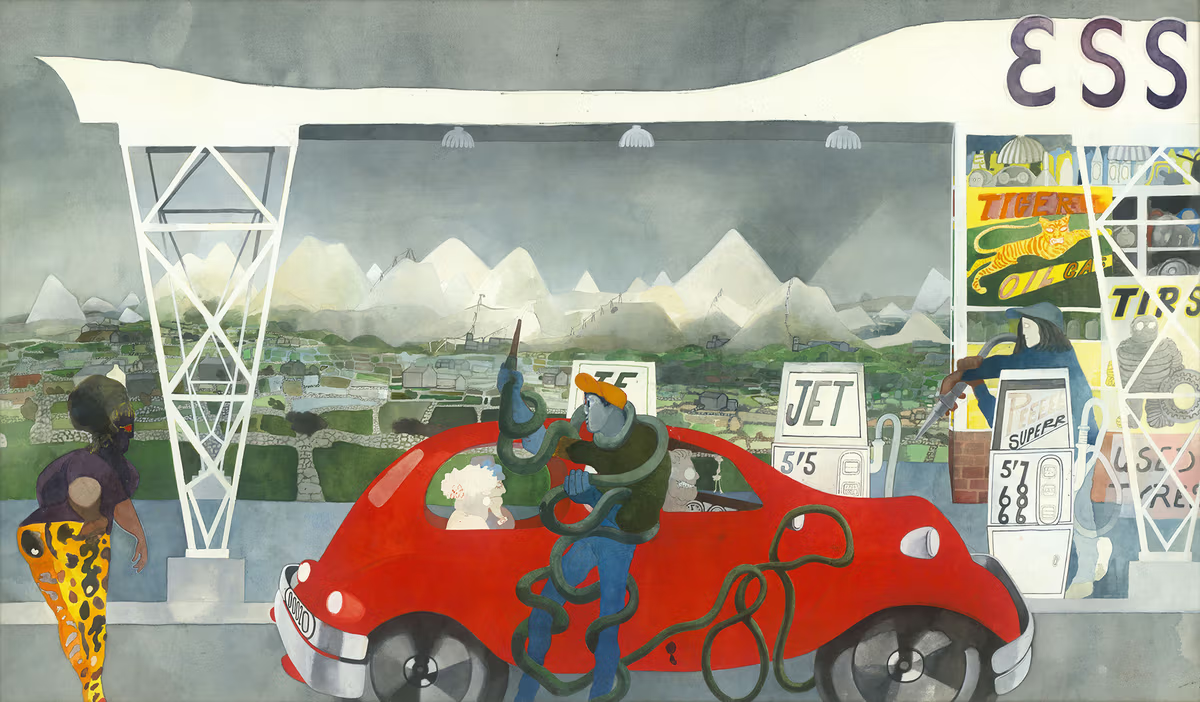
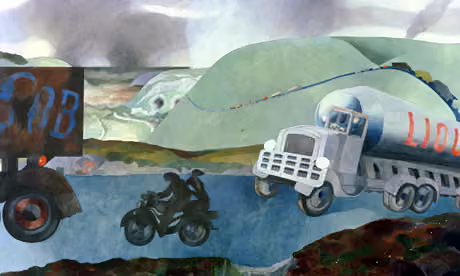
Neve shows us a strange and eccentric artist who in his final years turned to landscapes, investing them with the same unsettling distortions he once applied to figures. Rejecting consolation, he depicted ordinary features with grotesque intensity, turning views into scenes of aversion and unease. Driven around England by his sister, he observed the countryside from car windows and lay-bys, memorizing details with the detached sharpness that had once animated his nightclub paintings.
The Country Road, c. 1940The Cabbage Harvest 1943-45English Country Scene I, 1970An English Country Scene 2, 1970Landscape, Dartmoor 1974
Call a Psychiatrist
Asked about their meaning, Burra once replied: “Call in a psychiatrist.”
Neve explains:
With his air of subversion he made isolation a virtue. In some ways we are over-civilized. We are surrounded by, and constantly react to, art that insulates us against real feeling. That includes an easy view of landscape. In its place, Burra shows us a distraught countryside, in the hope that we may be unsettled enough to have some feelings of our own. (pp. 123–24)
He describes them further:
The landscape is empty because the traffic never stops. The pitiless, remorseless, nose-to-tail traffic; the mobile junkyard of half-human lorries which, snorting their own fumes and grimacing with effort, breast the hills to transport graffiti across intersections and over viaducts until the world is deaf and dumb and all the countryside shaken to bits. These machines can turn on each other, earthmovers bite bits out of one another with metal jaws, dog eat dog, and only the half-crazed Bank-Holiday pillion-rider, hair flying, cutting through the traffic, can be seen to be almost entirely human.
You who go out alone, on tandem or on pillion Down arterial roads riding in April … Refugees from cursed towns and devastated areas”(C. Day-Lewis).
Views across chalk Downs to factory chimneys in Sussex; the Weald seen from above, bulging like the bottom of a boy scout on a bicycle (!); the cloisonné pattern of Cornish fields broken off by the sea; Dartmoor ready to murder lost hikers; the Lake District with its knees up under a wet viridian blanket; an industrial town itching the lap of a valley; the scarred high places of Yorkshire and Northumberland; hills in Snowdonia like the stockinged heads of criminals; the Wye Valley in a vast gesture parodying Wordsworth and the Sublime. Everywhere there are the giant teeth of broken viaducts, dizzy quarries, white cauliflowers of smoke. Who will give you sixpence for a cup of tea, a cup of comfort, in such a landscape, where the insane traffic throws grit in the face of the receding hitch-hiker and all the meadow plants are poisonous? (pp. 122–23)
Not quite sure what to make of the “boy scout on a bicycle,” but bulging pneumatic hillsides, yes.
And so back to our poets In A Shropshire Lad (1896), A. E. Housman gave us the half-mythical Shropshire hills, standing for an older pastoral England untouched by modern change:
Into my heart an air that kills From yon far country blows: What are those blue remembered hills, What spires, what farms are those?
And T. S. Eliot, in East Coker (1940), turned the English village into something cyclical and unstable, pulled this way and that, at the mercy of change:
In my beginning is my end. In succession Houses rise and fall, crumble, are extended, Are removed, destroyed, restored, or in their place Is an open field, or a factory, or a by-pass.
All change, then: poetry, pylons, or pastoral hills – the scene is not the same, and neither is the poetry.
Thanks to you for bringing it to my attention! Yes. A magnificent book – rich with well-told stories and insights. And neve is certainly unafraid to say what he thinks. I’m going back now to re-read the Joan Eardley and John Nash sections.


 I was introduced to Griggs’ work via this review of Christopher Neve’s magnificent book




Brilliant post! The Neves paintings are terrific. And, in your usual style, you weave everything together in a most appealing way.
An impressive post!!!!!!!!
Kind of you to say that! Thank-you.
The Neve is stupendously good, isn’t it? The kind of book which sends you off in multiple directions exploring – lovely post!
Thanks to you for bringing it to my attention! Yes. A magnificent book – rich with well-told stories and insights. And neve is certainly unafraid to say what he thinks. I’m going back now to re-read the Joan Eardley and John Nash sections.